

Who Is Ed Zitron? A Deep Dive Into the Tech Industry's Fiercest Critic
The loudest bear on the AI boom is not a hedge fund manager, a famous short seller, or an economist with a doctorate. He is Ed Zitron, a British-born public relations executive who built his career promoting tech companies and now spends his spare hours dismantling the industry's story about itself, which leaves every AI investor with an uncomfortable question: is he the Michael Burry of this bubble, or just its loudest crank?
Who Is Ed Zitron? The Short Answer
Edward Benjamin Zitron was born in Hammersmith, London, in 1986 or 1987, studied media and communications at Aberystwyth University in Wales with a year on exchange at Penn State, and started out not in finance or tech but as a video games journalist for magazines such as PC Zone, per his Wikipedia biography. In 2008 he moved to New York, switched to tech PR, and eventually founded his own firm, EZPR, while writing two books about the publicity business, This Is How You Pitch (2013) and Fire Your Publicist (2018), and landing on Business Insider's list of the top 50 PR people in tech four times.
He still runs EZPR today, splitting his time between Las Vegas and New York, and his own account notes he has been published everywhere from The Atlantic to The Wall Street Journal. The detail that matters for a finance reader: he has no formal training in economics or computer science and has never worked in tech, learning the industry, in his telling, from inside the publicity machine that sells it.
From Flack to Firebrand: How a PR Insider Became Tech's Loudest Skeptic
In 2020 he launched a free newsletter, Where's Your Ed At, an often profane running critique of tech culture and management. The turning point came in February 2023, when a piece called The Rot Economy went viral and gave his whole argument a name.
From there the résumé fills fast: an April 2024 post, "The Man Who Killed Google Search," accused Google leadership of wrecking the company's core product to squeeze out more ad money, and in 2023 Cool Zone Media and iHeartRadio gave him the weekly podcast Better Offline, which later won a Webby award and made Esquire's and Vulture's best-podcasts-of-2024 lists.
His newsletter now claims more than 100,000 subscribers by his own count, and the mainstream press, from the Financial Times to Wired to Bloomberg, keeps profiling him as AI's skeptic in chief. If you have noticed he surfaces in headlines every time AI stocks wobble, that is no accident, and we have traced why the media keeps rolling him out.
The Rot Economy: Zitron's Core Argument
The Rot Economy's thesis is blunt: capital has become "entirely decoupled from the concept of what 'good' business truly is," and markets reward one "truly noxious metric," growth, meaning more rather than better. A company that keeps getting bigger gets forgiven almost anything, while a company that stops growing gets punished no matter how useful it is.
His exhibits from the 2023 essay include Meta losing $13.7 billion in a year on its metaverse division while the stock rallied on layoffs, Google letting search decay into an ad-stuffed maze, Uber celebrated despite a decade and a half of losses, and Adam Neumann raising fresh venture money after taking WeWork from a $47 billion valuation to wreckage.
His summary line, that "we have created conditions where we celebrate people for making 'big' companies but not 'good' companies," now gets quoted in speaker bios and conference talks. The idea rhymes with Cory Doctorow's "enshittification," whose author has appeared on Zitron's own podcast.
Why He Says the AI Boom Is a Bubble
Zitron turned to generative AI in 2023 and came away confused in a very specific way: large language models, he later said, "very clearly did not do the things that people were excited about," with no visible path to doing them. In September 2025 he filed the full indictment, The Case Against Generative AI, an essay of roughly 18,500 words arguing that the industry is a bubble that will "inevitably (and violently) collapse."
The technology case is that the models are unreliable: they hallucinate, and every mistake burns expensive computing power at the provider's expense. The economics case is sharper, and it is the part a finance reader should study, because he estimates the entire generative AI industry will book only around $44 billion of revenue in 2025 against more than half a trillion dollars already poured in, without a single profitable company building the models.
His most repeated exhibit is what he calls circular financing: Nvidia pledged up to $100 billion to OpenAI, structured so the money effectively flows back as payments for Nvidia chips, while OpenAI separately agreed to pay Oracle $300 billion for compute it cannot yet afford. Strip out Nvidia, Microsoft, and OpenAI themselves, he argues, and the data-center middlemen known as neoclouds, such as CoreWeave, Lambda, and Nebius, are left with barely a billion dollars of real outside demand.
He is far from alone in using the b-word: his essay links Sam Altman, Mark Zuckerberg, Alibaba's Joe Tsai, and Apollo economists all saying "bubble," and by late 2025 the Guardian reported that even the Bank of England had warned openly that AI hype could end in a burst. The difference is that Zitron wrote the case out in public, first, with receipts.
What Investors Should Take from Zitron, and Where He Might Be Wrong
You do not have to share his doom to steal his checklist. Before paying bubble prices for an AI story, ask who the customers actually are, whether disclosed AI revenue covers disclosed AI spending, and whether the headline deal reflects real demand or a circle of the same handful of players, the same discipline as separating a bargain from a trap.
One of his data points stings: Microsoft, he notes, stopped disclosing AI revenue in January 2025 after reporting roughly $13 billion annualized, and by his count fewer than 3 percent of its 440 million Microsoft 365 subscribers were paying for Copilot. If the best-distributed software company on earth cannot make the math work, that is a fact worth pricing, not a vibe.
The counterpoint is timing: across the same stretch, skeptics kept looking early as Nvidia's stock roughly tenfolded and the chipmaker became the largest company on the market, a company Zitron himself says now accounts for 7 to 8 percent of the S&P 500. Getting swept into a late-stage boom and panicking at the bottom is a classic pattern among sentiment-driven investing mistakes, whichever way this particular story ends.
Hype is a psychological event long before it is a financial one, and much of Zitron's reporting is really about incentives: what executives, investors, and journalists are rewarded for saying and refusing to verify. Manias are as much a behavior problem as a valuation problem, which is why the psychology behind money decisions is worth studying on its own.
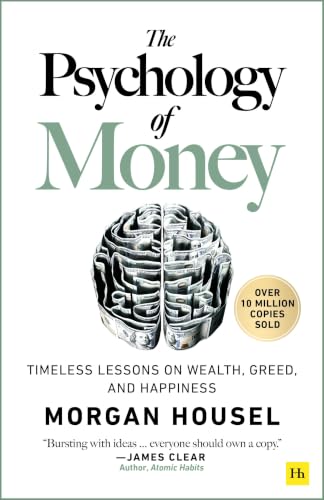
- 19 short stories on how emotions, ego, and luck drive money decisions
- Shows why staying wealthy is a different skill than getting wealthy
- The rare finance book about behavior, not formulas
The older defense against story stocks predates AI by nearly a century: Benjamin Graham's margin of safety, the rule that you never pay a price that already assumes the dream comes true. When a boom's bulls say "this time is different" and its bears say "none of it is real," Graham's discipline is to check what the business actually earns.

- Benjamin Graham's classic — Buffett calls it the best investing book ever written
- Teaches margin of safety and the famous Mr. Market parable
- Jason Zweig's commentary ties each chapter to modern markets
He has critics, including fellow skeptics: cognitive scientist Gary Marcus has groused that he made the same arguments for years and gets no credit in Zitron's narrative. Zitron's answer to doubters is characteristically blunt, "if I'm wrong, I don't know how I'm wrong," and he says most rebuttals amount to "wishcasting" that the AI simply gets better.
Where to Follow His Work
The newsletter, Where's Your Ed At, is free to read, and Better Offline ships weekly episodes. His next book, Why Everything Stopped Working, an argument that Big Tech ossified long before AI came along, is due from Penguin Random House in 2027, with just one chapter about AI.